
Is On-Demand Dust Collection Worth It When Most Machines Run Together?

Yes, if your dust collector spends enough time below peak demand to slow the fan and still move dust safely. If your biggest dust-producing machines need extraction together for nearly the whole shift, the fan may have little room to slow down. Before you price a retrofit, find out how long your system actually needs […]
Why Is Your Dust Collector Still Losing Suction After a Filter Change?

Installing fresh filters should restore hood suction right away. When you swap cartridges or bags, and your pickup hoods still barely pull dust, the restriction sits outside the filter media. A filter change only resets resistance across the tube sheet. It cannot clear settled dust inside pipes, fix a slipping fan belt, seal a leaking […]
Adding Machines? Can Your Existing Baghouse Handle the Extra Load?

Adding a machine should help your plant produce more. If its dust pickup weakens extraction elsewhere, the expansion brings a problem your original layout never had to handle. The connection may look simple, but the demand on the baghouse changes. At Air Quality Systems, we supply baghouse dust collectors, replacement filters, and spare parts for […]
Industrial Air Filtration System Design: Why Sizing from Floor Data Beats Rule-of-Thumb Guesswork
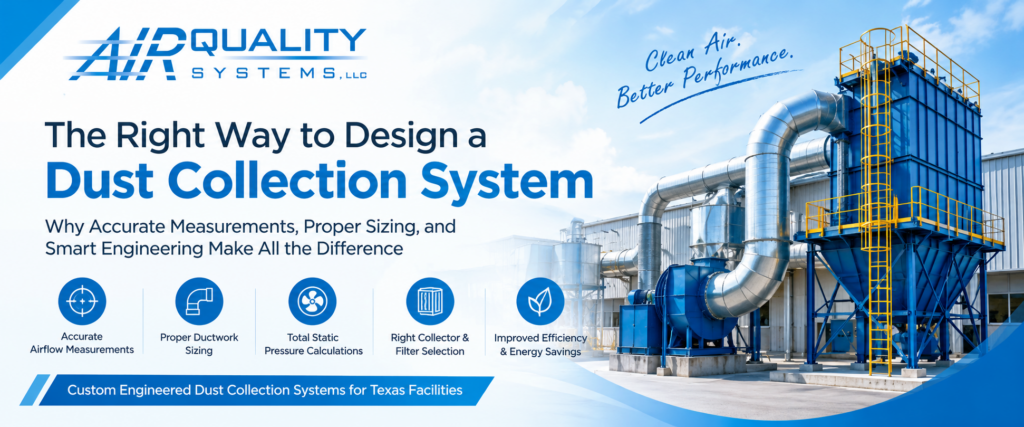
A dust collector is only as good as the system design behind it. When a plant struggles with airborne dust, the common reaction is to blame the collector or buy a larger fan. In most facilities, however, the equipment is rarely the problem. The failure began when someone sized the system using catalog rules of […]
Industrial Air Filtration Inspections in Texas: What Gets Checked and What Happens Next

An industrial air filtration inspection checks airflow, pressure, and equipment condition to help you understand how your system performs. The findings guide your next decision: adjust the system, schedule maintenance, or investigate a problem further. At Air Quality Systems, we evaluate these conditions and recommend adjustments where needed. From our Allen base, we serve facilities […]
Troubleshooting Industrial Dust Collectors in Texas Humidity: Fixing Moisture, Blinding, and Hopper Jams

When summer humidity hits Texas, dust collector pressure gauges spike above 6 inches, and pickup hoods lose suction. Buying replacement filters immediately wastes money. If you do not fix the moisture source, new filters will choke again in two days. When seasonal weather causes sudden airflow loss, professional industrial air filtration troubleshooting in Texas helps […]
Daily, Weekly, Annual: What Industrial Air Filtration Maintenance Should Cover and How Often
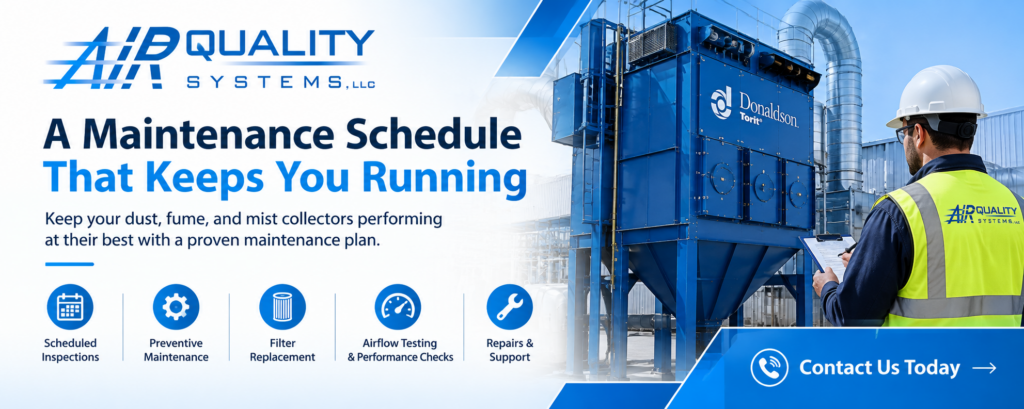
Most dust collection schedules get set once, by whoever commissioned the system, and then drift. Filters get changed when someone notices the gauge. The hopper gets checked after it backs up. This is the cadence we work to for industrial air filtration maintenance in Texas. Your team handles the daily and weekly checks, the monthly […]
Caked Dust Collector Filters? How to Fix Moisture and Airflow Issues in Your Texas Facility

When your differential pressure gauge stays pinned above 6 inches despite continuous pulse cleaning, your dust collector is choking. Airflow drops across your pickup hoods, shop air turns hazy, and production slows down. Caked filter bags are not routine wear. They indicate compressed air moisture, undersized housing airflow, or hopper jams. Left uncorrected, high differential […]
Cartridge Dust Collector vs. Baghouse: Which System Fits Your Facility’s Dust Load and Footprint?
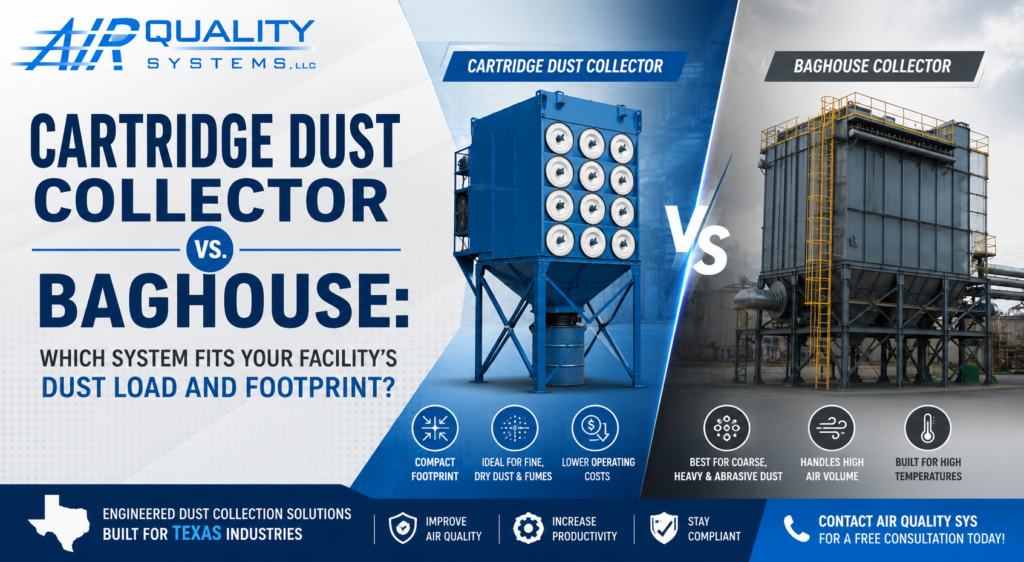
Choosing between a compact cartridge filter dust collector in Texas and a traditional baghouse depends on particle size, dust volume, and floor space. At Air Quality Systems, we have engineered industrial air systems across Texas for over 20 years. As an authorized Donaldson® Torit® dealer, we help plant managers choose the right system to prevent […]
Cartridge Filter Parts in Dallas: How to Cross-Reference, Measure, and Order the Right Replacement
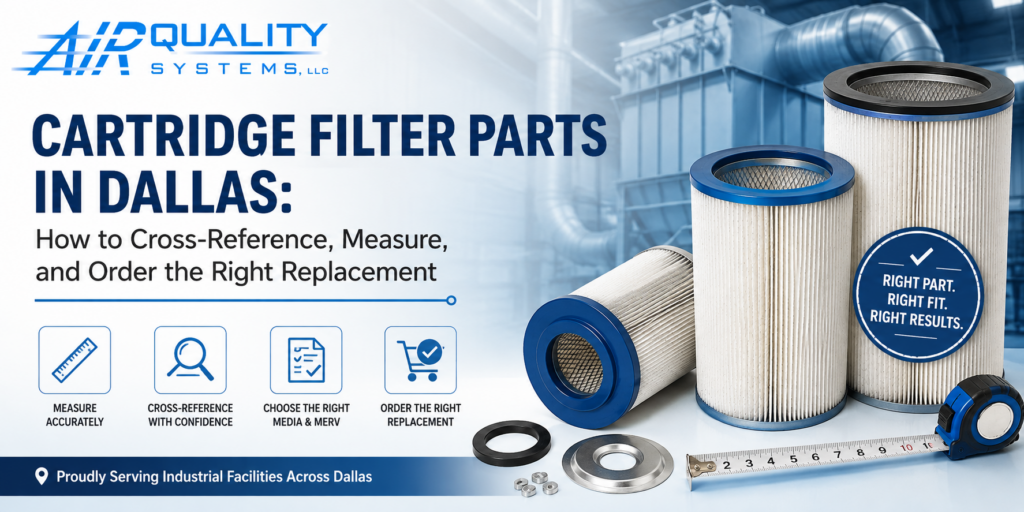
Ordering the wrong replacement cartridge costs more than the part itself. It costs downtime, a second shipment, and a system that never quite seals right again, especially when the original part number is worn off or the filter came from a brand your usual supplier doesn’t stock. At Air Quality Systems, we offer high-quality industrial […]